
Myron Barlow
Product Details
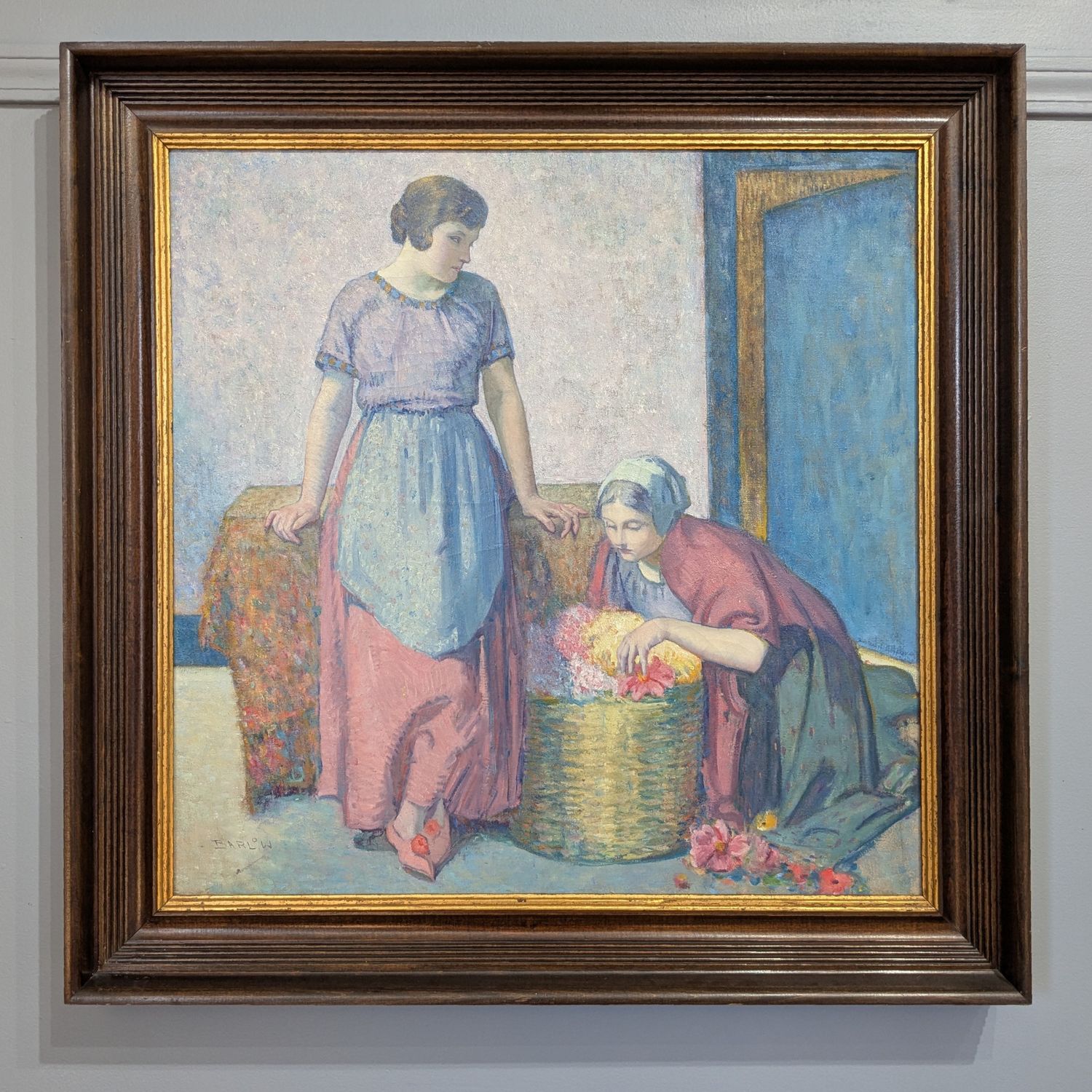
Myron Barlow, American, 1873-1937. An early 20th century interior scene with two women and a basket of flowers, titled "Flowering". Signed “Barlow” lower left, titled on Flint Institute of Arts label verso. Image 29 x 29" high, framed 35 3/4 x 35 3/4" high overall.
*Note: All works can be shipped, please contact us at 734-434-2660 or info@schmidtsantiques.com to request a shipping estimate.
Biography:
Born in Ionia, Michigan, in 1873, Myron Barlow studied at the Detroit School of Fine Arts before continuing his training in Paris at the Académie Julian under Jean-Paul Laurens. By the early 20th century, Barlow had settled in the village of Île-Tudy, where he became closely associated with a community of expatriate artists drawn to the region’s traditional rural life.
Barlow’s work is distinguished by its quiet, observational naturalism and a refined, decorative use of color. Around 1909, his palette underwent a notable transformation, shifting from the darker tonalities of his earlier work toward harmonious grays, blues, and mauves. Contemporary critics described these atmospheric compositions as “dreamy studies” and praised their delicate, reserved color harmonies. By the 1910s, Barlow had become particularly associated with what reviewers termed his “blue pictures,” characterized by high-key palettes and figures set against pale or nearly white backgrounds. His compositions often center on Breton women engaged in everyday domestic tasks, rendered with a sense of stillness and dignity. Flattened spatial construction, soft contours, and carefully balanced color relationships reflect an awareness of Post-Impressionist and Symbolist tendencies while maintaining a commitment to figural clarity. Patterned textiles, simplified forms, and subtle tonal harmonies lend his scenes a contemplative, almost timeless quality.
Elected an Associate of the National Academy of Design in 1910, Barlow exhibited widely in the United States and France, earning recognition for his sensitive portrayals of rural life and his distinctive synthesis of academic training and modern stylistic restraint."
1910, Barlow exhibited widely in the United States and France, earning recognition for his sensitive portrayals of rural life and his distinctive synthesis of academic training and modern stylistic restraint.